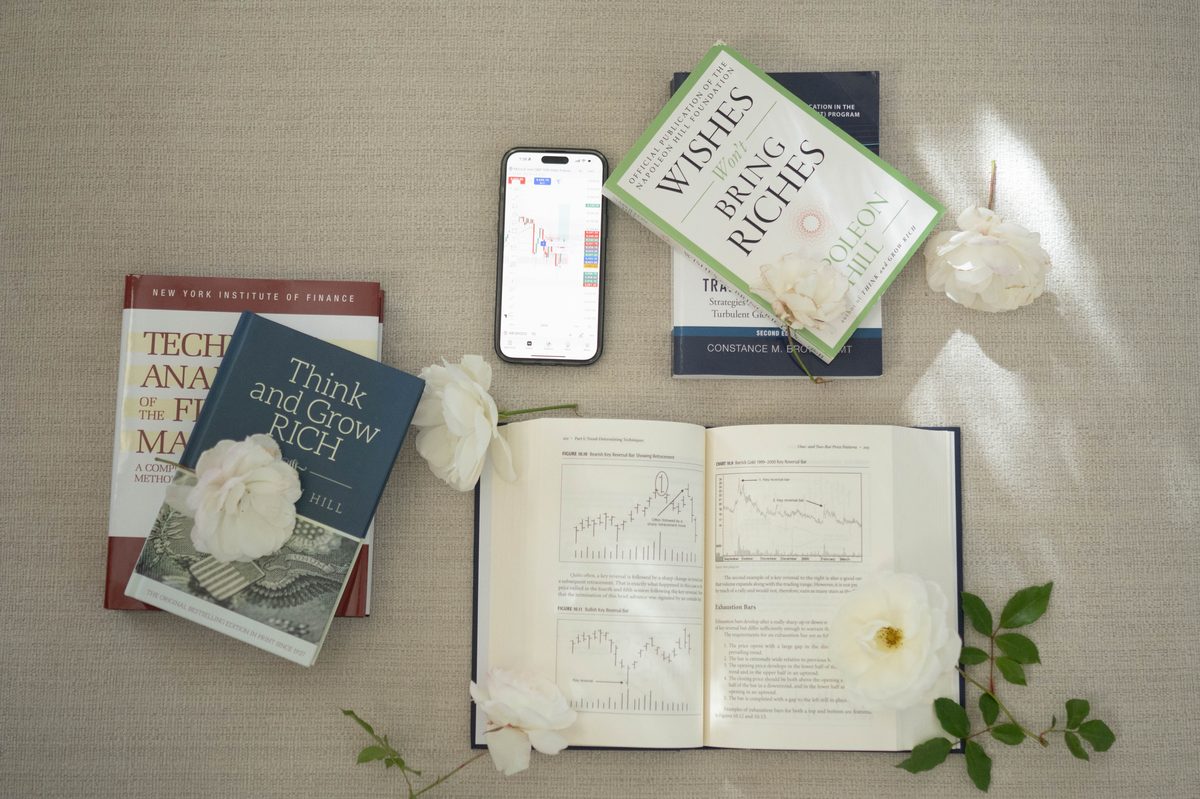
I've been teaching women to trade for two years now, and there's something I notice in almost every cohort. The traders who succeed aren't the ones with the smartest strategy. They're the ones who understand that trading isn't a game you win by outsmarting the market. It's a discipline game. It's about showing up the same way every single day, following a plan you've already decided on, and letting patience do the work while your brain tries to convince you to break.
The gap between a profitable trader and a broken account isn't technical knowledge. It's psychological. And that's what this guide is about — not just what to do, but who you need to become to do it consistently.
The Complete Guide to Trading Psychology
When we talk about trading psychology, we're really talking about the distance between knowing what you should do and actually doing it when your account is bleeding and your hands are shaking. That gap? That's psychology. And it's bigger than most people realize.
You can know everything about support and resistance, RSI, moving averages, and still blow your account in a week. Why? Because the technical knowledge lives in your brain. The psychology lives in your nervous system. Your brain wants safety. Your nervous system wants to run from pain. When money is on the line, your nervous system wins every time — unless you've trained it otherwise.
This is why one of our members, who joined thinking trading was about clicking buttons, spent an entire year in demo before going live. It wasn't because she needed more chart knowledge. It was because she needed to reprogram her relationship with money, risk, and her own competence. One year later, she's a full-time trader. The charts didn't change. She did.
:::coach-insight{name="Jemma Wilson, TFW Mindset Coach"} "I'm fearful of change. I'm fearful of believing that it's possible. It's like we plant all these little fears and doubts, and that emotion just hangs heavy over us. Unless we're consciously aware of what's fear-driven and what's intuition-driven, we stay stuck." :::
How to Build Emotional Discipline as a Trader
Discipline isn't motivation. Discipline is deciding something matters more than how you feel in this moment. It's the difference between intention and execution.
In trading, emotional discipline shows up as:
Following your stop loss when everything in you wants to move it. You set that stop loss before the trade was painful. You decided it was acceptable to lose that amount. But now the trade is down, and your mind is thinking, "If I just move it a few pips..." and you can already see yourself being right. Don't. The stop loss is a decision you've already made. Honour it like it's law.
Leaving winning trades alone. Overconfidence creeps in here. You're up three trades in a row, feeling good, and suddenly you think you can scalp tighter, take bigger positions, or trade outside your rules. You can't. The rules are there to protect the version of you that shows up when you're emotional — and overconfidence is an emotion.
Taking trades you've planned and NOT taking trades that look "good." This is where most traders fail. They skip their setup because "it doesn't feel right" today, then see it move perfectly and feel FOMO. Or they see a setup that isn't on their list and jump in anyway because "this one's different." These are just different ways of breaking discipline. The market will always offer another trade tomorrow. Your plan only works if you execute it.
Setting a daily trade limit and actually stopping. Not "I'll stop after one more." Actually stopping. One of our biggest breakthroughs with trading psychology was realizing that traders who lose the most are the ones who overtrade after a loss — they're trying to recover emotionally, not strategically. So we set daily limits. Not to limit opportunity. To protect you from yourself.
:::community-story{attribution="— TFW member"} "I am the first to admit — I am a slow learner. I'm 59 years young and I LEARNED SOMETHING NEW! I was afraid, I doubted myself. I had limited thoughts about financial abundance. But I kept going, watched and rewatched classroom recordings, joined every new session offered, and committed myself to this journey." :::
The beautiful part? Discipline builds on itself. After you follow your plan three times and hit profit on two of them, something shifts. You start to trust the process. The emotional pull weakens. You're not white-knuckling through the plan anymore — you're just executing what you know works.
:::highlight-box **What we teach:** Your trading plan is only powerful if you follow it. The goal isn't to feel confident while trading — it's to trade the same way whether you feel confident or terrified. Discipline removes feelings from the equation. :::
Patience: The Weapon Most Traders Won't Use
Everyone wants fast profits. That's actually one of the biggest psychological traps. The market will give you opportunities to scalp, to swing, to hold long-term — all of them profitable if done right. But the traders who blow up fastest are almost always the ones chasing speed.
Think about it this way: if you make five trades a day and three of them are mediocre setups you took because you were bored, you're not trading your system. You're just in the market. That's not patience. That's the opposite.
Real patience in trading looks like:
- Waiting for your exact setup — not taking the "close enough" version because you're tired of waiting. If you're looking for a daily close above resistance, don't take it when price just touches it intraday.
- Holding winners longer than your emotions want to. I see this constantly. Traders hit their take profit target and jump out, then watch the trade go 3x further. They knew they should hold, but fear of losing the win kicked in. Patience means trusting your rules enough to let them play out.
- Waiting for the next trading day instead of taking "just one more" trade. The market opens tomorrow. Your edge exists tomorrow too. Getting one extra trade today isn't worth breaking your system.
- Staying in demo longer than you think you need to. This is the hardest one to sell people on. But traders who spend three months in demo before going live have a dramatically different success rate than traders who go live in three weeks. The market doesn't change. Your psychological readiness does.
Patience compounds. A trader who takes ten high-quality setups a month makes more money than a trader who takes a hundred low-quality setups. This is mathematically true in every timeframe, every market, every strategy. But the second trader feels busier, more active, more engaged. So they stick with chaos.
:::coach-insight{name="Amanda Custer, TFW Founder"} "You need to wake up every morning and set the emotion for the day. Before you do anything else, choose the energy you're carrying into the charts. That intention carries through every decision you make." :::
Trading Journal: The Most Underrated Psychology Tool
Here's what separates traders who improve from traders who just repeat the same mistakes: journaling.
Not just recording wins and losses. That's scoreekeeping. Real trading journaling documents your mindset, your emotional state, why you took the trade, what you felt during the trade, and what happened afterward. It's brutally honest self-reflection.
After about twenty trades, patterns emerge. "I always cut winners short on Mondays." "I overtrade when I'm stressed from work and didn't sleep well." "I chase entries when I've missed the first two setups of the day." These aren't moral failures. They're just information. Once you see the pattern, you can design around it.
One of our members realized through journaling that she was making decisions differently depending on whether she'd had coffee. Sounds silly, but it's real. Her impulse control literally depended on caffeine. So now she doesn't journal until after her coffee, and her trade quality improved immediately.
Your journal should include:
- The setup you traded (what did you see on the chart?)
- Your entry reason (why did this match your rules?)
- Your emotional state during the trade (confident, anxious, frustrated?)
- How you managed the trade (did you adjust stops, second-guess, close early?)
- The outcome (win, loss, breakeven)
- What you'd do differently next time
Three months of detailed journaling and you'll understand yourself as a trader better than you understand your strategy. And that self-knowledge? That's where real improvement happens.
:::community-story{attribution="— TFW member"} "I passed my first prop firm today! I have failed so many before and just kept getting back in there. What was different this time? I spent the week putting all the wisdom from our leaders into practice — including documenting every decision and emotion in my journal." :::
The Psychology of Overconfidence (And How It Destroys Accounts)
Overconfidence is the flip side of fear. Both destroy accounts. Both come from the same place: not trusting your system.
After three winning trades, your brain wants to celebrate. After five, it wants to break the rules "just this once" because you're obviously skilled now. After a week of wins, you've already convinced yourself that you're a natural, that the rules are restrictions, that you could probably handle bigger positions.
This is when discipline becomes hardest. Because now your emotions aren't pulling you away from the plan — they're pulling you toward breaking it, and it feels justified.
The traders who maintain consistency do something simple: they trade the same way whether they're up or down. Same position size. Same rules. Same daily limits. The rules don't change based on performance. That unchanging structure is what keeps profits compounding instead of turning into losses.
Overconfidence is just fear in a different outfit. Both are emotions. And emotions should never be the boss of your trading plan.
Building a Psychology Practice (Not Just a Trading Practice)
Real traders know that trading psychology isn't something you master once. It's a practice. You show up every day — in and out of the market — working on it.
This looks like:
- Morning routine. Set your intention before the market opens. What emotion are you bringing? What's your plan? Are you trading today or sitting out?
- During-market discipline. Follow the plan. Don't let profits make you cocky. Don't let losses make you desperate. Just execute.
- End-of-day journaling. Document what happened, how you felt, what you'd change. Look for patterns.
- Weekly reflection. Look back at your trades with fresh eyes. Are you following your rules? Are there emotional patterns repeating?
- Personal development. Read books on psychology and mindset. Listen to coaching calls. Do the work on yourself, not just on charts.
The women in our community who make this a daily practice don't just trade better — they live better. Because you can't compartmentalize discipline. If you're disciplined with your trading plan, you tend to be disciplined with your health, your relationships, your goals. It all flows together.
This is why we say trading is personal development with a profit motive, not the other way around. The charts are just the arena where you're learning about yourself.
Your psychology is the foundation. Your strategy is built on top of that. And your success? That's what happens when you commit to the entire stack — not just the exciting chart parts, but the unsexy, repetitive, disciplined psychology work that actually makes you money.
That's the complete guide. Not indicators. Not timeframes. Not some secret edge. Just honest truth about who you need to become to stay in this game long enough to win it.
Related reading: fear and doubt in trading, money mindset shifts, and trading morning routine.